Thursday, July 26, 2012

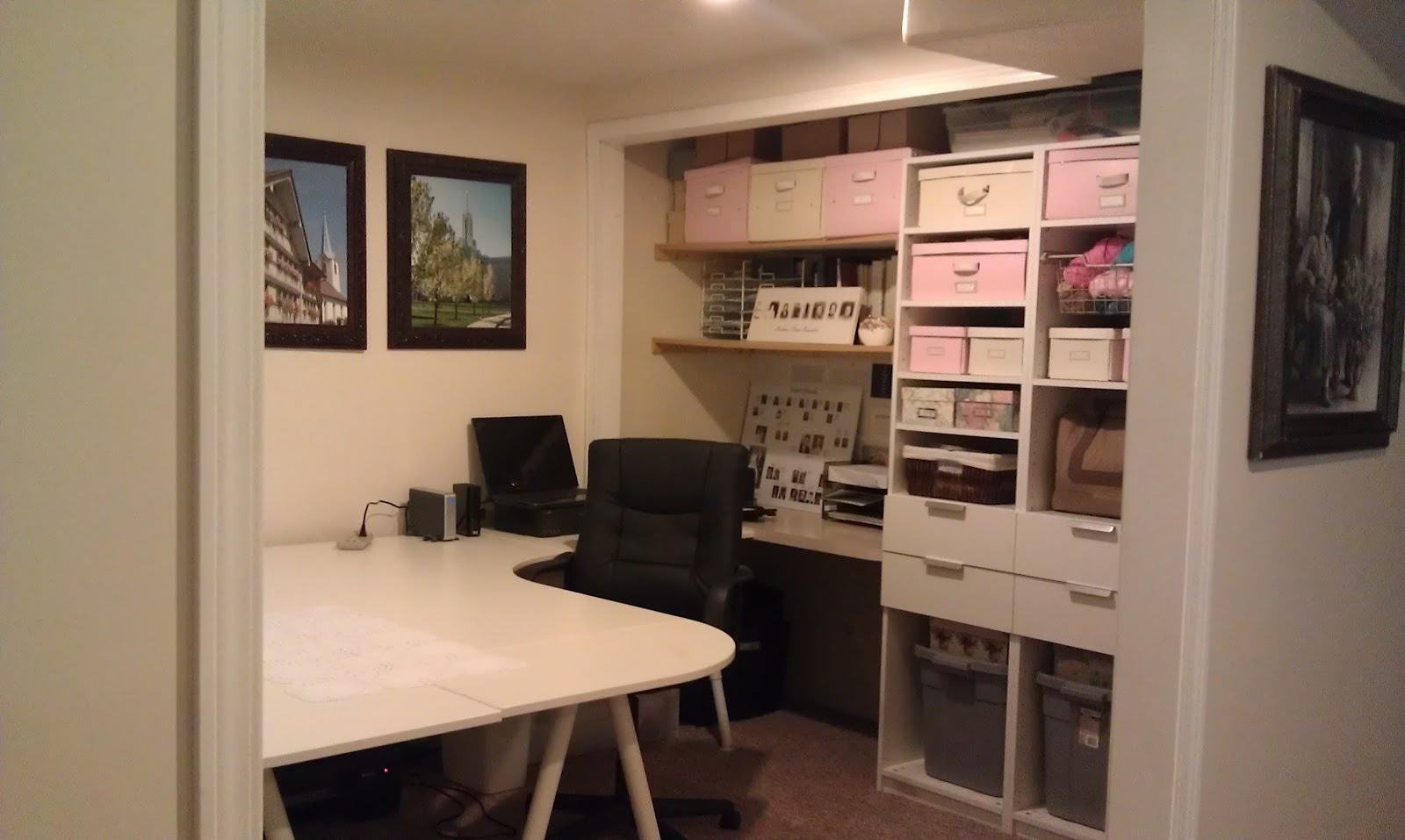
Tour of our offices

We had a pipe break and our offices have been torn up this summer. It has taken too long to get things straightened out because we've been too busy with family reunion season to be able to deal with it much.  I'm so thankful the company that is taking care of it has been great to work around us.  I'm missing our usual arrangements, so I'm going to show them to you here.  Hopefully the good vibrations will get things back to normal quickly. 
Entrance.  I love the logo on the wall.  It reminds me of our goals "Share, Honor, Inspire."  I love that.  I love what we do.

The main work room.  Big cutting table, laminator, marked with all of the places around the world where we've shipped charts.  The Generation Maps logo is still on that wall.  We've come a long ways baby.
Several of the plotters and the paper.  4 stretched canvases of fall shots that I took one year.  I love autumn.
Ok.  confession.  This is where a little bit of my regular life invades the offices.  This wall is full of craft supplies and around the corner is my sewing machine.  This part wasn't affected so much by the pipe leak but I'm afraid they are going to have to move everything when we recarpet.  I'm sure it is going to be fine when they put it all back.  (thinking good thoughts.)
My office.  Too many computers, lots of pictures of the kids, a few blogger beads, Egyptian papyri, pink, floral, me. 
Kim's office.  There is usually alot more going on than you see here. 
Our other office for when our employees come in.  They work alot from home, but when they come in they have a clean space where they can concentrate.
The print server station.  My syllabi from all the years of conferences overfloweth.  Lots of good reference.  

The good news is we get new carpet throughout and I really love the carpet we picked out.  We have been able to keep up with customers but now you know why the blogging has been sparse.  We will be put back together by the end of  the week--and it will all have that wonderful smell of new carpet.  Wish us luck.

Sunday, July 22, 2012

Pioneer Days in Utah


If you've ever been out of the country at Thanksgiving or through December, you've probably noticed how the rest of the world only celebrates "the holidays" from Christmas to New Years.  But in the US, we get to celebrate for an additional couple of weeks starting with Thanksgiving in November.  Americans celebrate with parties the whole month, stretching out the enjoyment of the season for weeks. 

In Utah, we have that same luck in the summer because the patriotic/historical season lasts an extra couple of weeks.  When you are in Utah at the end of July, you simply must do as the locals do--Celebrate the 24th of July.  We get extra fireworks and parades and everything.  Known as Pioneer Day or the Days of '47, it is a celebration of the arrival of the first pioneer settlers in the Salt Lake Valley on July 24th 1847.  It is a founder's day celebration of sorts--only bigger than you've probably seen other places.  There are great parades, family barbeques and and events across the state.  Everyone takes a break and enjoys another summer holiday.

In Salt Lake many families will grab the blankets and sleeping bags and camp out the night before with the huge slumber party that happens along the parade route.  Then at 9am on the morning of the 24th, the parade starts, with great floats, bands, antique cars and thousands of people celebrating.  The map of the route can be found at the official parade site

That evening, the place to be is the Maverik Center at the Days of 47 Rodeo.  Nationally known professional cowboys compete for prizes in several different events.  The rodeo actually goes for several nights (starting this year on the 19th) culminating in the last evening on the 24th.  Tickets can be purchase at the rodeo website.

But I think the best way to celebrate the 24th is with a visit to This Is The Place State Park. They celebrate Pioneer Days with special events, including a breakfast at the Huntsman Hotel, a flag ceremony, pioneer games, the watermelon eating contest, the candy cannon and lots of pony rides and special craft projects.  You can really get into the pioneer spirit learning more about the settlers to the area amid the historical buildings and talented interpreters. 
Of course the 24th of July is special to me because it is my Dad's birthday.  He always said the fireworks were for his birthday, not the holiday.  This year he won't be in Utah for his birthday.  We'll have to do the celebrating for him I guess.  Have a fun and safe 24th of July.

Friday, July 20, 2012

The UGA Cedar City Conference

Cedar City's first ever Family History Conference will be held Aug.18, 2012 at the Hunter Conference Center on the Southern Utah University campus. It will be a one day event with sessions on local history presented by people in the know.  We will have presentations on Historic Trails of Southern Utah, the Frontier Homestead State Park, and the First Settlers of Cedar City.  There will also be classes on how to do foreign research including Scandinavian, Irish, and English research.

Presenters are coming to teach  about how to write our family histories, teach about DNA genealogical research, and reading Early American Handwriting.  There will also be sessions that are just for fun including story telling and music from the past. The day will begin at 8;30 A.M. with keynote speakers Dixie and Anne Leavitt and the the day will end at 4:30 following a closing address from Harold Grant Shirley.  Come and spend a special day with us on one of Utah's beautiful college campuses.  Registration is online at the Utah Genealogical Association website found at http://www.ugagenealogy.org.

Family ChartMasters will be there.  Be sure to stop and say "Hi."  And while you are at it, Cedar City is the home of Utah's Shakespearean Festival.  Stay an extra day to take in a world class play while you are there.  You'll be glad you did.

Thursday, July 19, 2012

Catch up on conferences

Catching up with what we've been doing.  Great conferences and lots to do.  It has been a great summer.  I'm thankful that we've been so busy with family reunion season that I haven't had time to blog.  But I have lots to tell you about.
At NGS in Cincinnatti I got to have a booth next to Jill Crandall of Research Ties.  Very innovative new product to help you track your research.  Take a look at www.researchties.com.  Still in development but you can sign up for the beta at the website. 
 Dear Gena Philibert-Ortega was there with her new book, From the Family Kitchen: Discover Your Food Heritage and Preserve Favorite Recipes.  It is a fascinating book about the heritage of food and historical recipes.  It includes space for your own recipes.  I bought a copy for my Mom for Mother's Day.  You can check it out at Amazon and try the Cheese Straw, Hominy, Johnny Cake or Ox Tail Stew recipes yourself. 
 It is always good to see Candice Buchanan and Glenn Toothman of Memory Medallion.  More on that to come.  Such good people.  I just love the people we get to work with in genealogy. 
 Stopped to pick up something from Maia's Books.  She collects the greatest historical games and things for kids. 
 And it was so fun to see Tara Meitzler of Family Roots Publishing.  We so appreciate them.  It was especially fun to see Tara because she brought her new baby.  I didn't get a picture of Leland carrying the baby around but you could tell he was a proud grandpa.  I think grandpa and new grandbaby are really bonded because their hairstyles match.  :)
 Of course we love Bruce and Laurie Buzbee of RootsMagic.  Don't usually get to take pictures of them though because there are always people at the booth and they are always busy talking to someone. Congratulations to them on Elizabeth Shown Mills' endorsement at this conference.  ESM uses RootsMagic.  Kudos.
 And here's the group at My Heritage.  Shelly Mark and Daniel are holding down the fort.  It was great to have a few minutes to talk to them. 
 A good picture with one of my favorite ladies--the Photo Detective Maureen Taylor.  She brought me a cupcake treat just when I needed it.  Thanks Maureen!
 The best part was the food of course.  I'd already fallen in love with Cincinnati Chilli when Erin had made it for me.  She has a great recipe and grew up in Cincinnati so I've had it several times.  Luckily Allison Dolan lives there and I was lucky enough to have her show us where the best Chilli parlor was.  The great talk with Lisa Louise Cooke and Allison on the way made it even better.  I got to share a room with Lisa at this conference.  What a treat. 
 MMMMM.
 Then we also went to SCGS.  Always a great conference.  More on that to come too.  While I didn't get lots of pictures, I did get this great one.  We brought our pedigree quiz game to try out on the SCGS attendees.  Gini Webb's daughter Emma won our high score.  She answered all the questions correctly--some of them were quite hard.  Way to go!
It was fun to bring Randy Seaver, Gini Webb, and A.C. Ivory and their families along to the favorite restaurant we always go to with the Buzbees.  So good to have time to talk to everyone.  I really appreciated Randy's write up about my lectures at SCGS.  I think they went well.  Genealogy conferences are so much fun.  Looking forward to the next ones.  I'll try to take more pictures as they come.

Tuesday, May 22, 2012

Book Review

Dick Eastman reviewed my Guide to Salt Lake City this week.  I'm so glad he liked it.  And I've gotten lots of emails that it has helped other people.  It is so good to be able to help people have a good time in Salt Lake.

I'm working on a revision.  City Creek Center has opened now and I have some other things to add too.  If you have any suggestions, let me know.  If you want to be notified when the revision is done, you are welcome to sign up for our newsletter at http://www.familychartmasters.com/newsletter.  We'll let you know when the new version is ready.

Saturday, May 5, 2012

New UGA Pioneer Tours

This announcement is from UGA.  Our family had a great time on this tour last year and I know you'll enjoy it if you can go this year. It is the one day of the year you can get into Cache Cave, a fascinating place where lots of pioneers had carved their names.

The Mormon Trails Chapter of the Utah Genealogical Association is going to host two bus tours this year along the original pioneer trail coming into the Salt Lake Valley. The tours will run concurrently begining at 7:30am from the Henefer Park and will end at Henefer Park at noon where lunch will be served.
Tour One is through the Echo Canyon trail traveled by 80,000 Mormons immigrants on their way to the Salt Lake City Valley. Learn the stories of the pioneers and explore where they camped and where many of them carved their names on the wall of Cache Cave. Other sites on the tour include: Castle Rock, Hanging Rock, Billboard Bluff, the Mormon Fortifications, Mormon Vanguard Camp (July 16, 1847) and Weber Station. You’ll also see Echo City, Historic Echo Church & Museum, Needles and Witches rock formations, Supplement Hills, Monument Rock, Pony Express Monuments, and Lincoln Highway.
This exciting tour will be given by John Eldredge author of "The Illustrated Emigrants’ Guide". My family and I took this tour last year and found Eldredge’s historical knowledge remarkable and his ability to tell about the artifacts among the ledges and emigrant trail amazing.  I learned all sorts of things about the pioneer's trek into the valley.
Then, new this year is the Tour Two: the East Canyon trail Tour. On this section of the trail you can see rocks that still have rut marks made by the slipping of wagon wheels more that 160 years ago. This was the hardest terrain the pioneers crossed and it is filled with some of the saddest stories. Some of the sites you will see are: East Mountain, Pratt’s Pass Camp, Spring Creek Station, Wagon Ruts, Dixie Pony Express Station, Martin’s Cove of Utah, Broad Hollow Trail Marker, Canyon Creek Crossing, Bauchmann's Pony Express Station, the Carson House and the Daughters of the Utah Pioneer Cabin and Museum.
Your guide for this exciting tour will be Linda Smith, Morgan County Historian. This tour ends at the DUP Cabin and Museum.
Date: Saturday June 16th, 2012
Place to Meet: John's Park in Henefer
Time: 7:30 am
COST: $25 for UGA Members for complete tour and lunch
$30 for non UGA Members for complete tour and lunch
$20 for UGA Members or $25 for non UGA members for tour without lunch
To register for the tour, go to www.ugagenealogy.com.  Deadline for enrollment is May 22, 2012.
Lunch: French Dip Sandwiches, salads, chips, brownies and ice cream.

Tuesday, April 24, 2012

Grandma's Flak Jacket

I received a wonderful email last week after my SCGS webinar, "Grandma's Flak Jacket: Why your children need you to do genealogy."   The email illustrates so beautifully how nourishing family history is, even when there are hard things going on in  your family.  Jo-Ann said I could share the letter with you, so here it is.   I hope it inspires you as much as it inspired me. 

Hi Janet,

I attended your webinar last night (am the one who's husband's father was one of 22 children... he's also Swedish).  I've attended probably a dozen different webinars over the past year and most have been very good, but yours was different.  I've not felt compelled to contact a presenter afterwards, but this time I have to.  Your talk touched me like none of the others have. 

I come from a very dysfunctional family, with alcoholism, drug addiction, sadism and lots of irrational (and unsavory) behaviours.  Thusly, there was never any closeness and no one ever talked about family history.  I am 56 years old and about 3 years ago, just on a whim, I decided to draw up my family tree.  I was stuck almost immediately on my paternal grandfather.  My Dad (now deceased) was entirely unapproachable on the subject, but he had 2 sisters.  He was on good terms with one, but estranged from the other.  We were never allowed to talk to that second sister because she was apparantly so horrible.  Trouble is, the first sister was like him and would not discuss the family, so my only choice was to approach the second one.... even though I was risking being disowned for doing so.  My whole world changed at that point. 

Not only was she not horrible, she was WONDERFUL.  She was thrilled to hear from me and shared openly.  She inspired me beyond all belief and I am eternally grateful to her for that.  She is 82 years old and I regret all those lost years.  But it is what it is and at least we can carry on from here with love instead of resentment and maybe heal some of those hurts.  I guess you could say I am now obsessed with genealogy, making it practically my full time job.  I think what drives me is that need for connectedness.  I have come to believe that I am part of something much bigger and I finally feel "a part of".  I've had some of those woo-woo moments that you talked about last night and those are very cool.  I absolutely love having made contact with previously unknown relatives and especially being able to share things with others that they did not know before.  And have put people together that otherwise may never have found each other, or even known of their existence. 

There was one defining moment, which may sound like nothing, but it impacted me.  My grandfather emigrated from Scotland to Canada.  He was following his sweetheart who had emigrated the year before.  They married, had children and when the Great Depression hit he had to travel to the other side of the country for work.  For various reasons, they never reunited.  Once he landed work he sent for her and the children, but her family interfered and prevented her from going.  Very sad.  She always kept his picture beside her bed until her dying day some 70 years later.  It breaks my heart to even tell this story.  But the haunting question is... whatever happened to him?  I have really tried hard to find him, but so far to no avail.  I did trace him to a town in 1935 and had the strangest sensation when I first saw his name on the printed page of the City Directory.  Nothing earth shattering.  Just a phone book.  But it was him.  He was real.  I felt a connectedness I had never felt before.  Was weird.

I'm still searching for him and will not give up.  I don't know what kind of man he was.  I like to believe he was good, even though he had a brother who was very much NOT good.  My Dad and his one sister hated their father their entire lives because they believe he abandoned the family, but I don't think they had all the facts.  I think they robbed themselves by not trying to learn and understand why their parents did what they did.   They preferred to carry the hurt.  So... because the trail on grandfather went cold quite quickly, I turned my attention to his wife's family and have mapped out quite a large tree.  Details have come much more easily and I've made many contacts.  Here is where I'm finding more than just the facts.  I'm learning of behaviours and personality traits and seeing very clear patterns.  It really explains so much of how and why my family (and it's branches) is the way it is.  It allows me to have more compassion.

And physical traits.... there's a whole 'nother fun subject.  My grandmother was from Scotland but her ancestors were from Ireland.  Her surname is rare, so I've been making a one-name study of it and tracing everyone I find with that name.  I have mapped 3 major branches and traced them all back to the same place and time.  I just can't prove the link, but there have been tip offs.  Like pictures of 2 men, each from a different branch.  They look so much alike they could be brothers.  Another story is I found a second or third cousin recently and he sent me a picture of the GG-grandparents we share.  It took my breath away to see that GGGF and my nephew are spitting images of each other.

This whole subject is awesome, awesome, awesome!  I would love to publish my findings some day, to pass down to future generations.  I often sit and think what life was like for my various ancestors and picture myself standing beside them in their time.  I also wonder what they would think about how hard I'm working to learn about them.  What would they have thought about someone being so interested in them as they were just living their ordinary lives.  Will someone in the future be this interested in me and what I am doing today in MY ordinary life?

Anyways, I've written much more than I intended to.  I just wanted to thank you for the webinar and confirming that I'm not the only one who approaches my research with these same thoughts and intentions.  I don't even know if I've adequately articulated what I am trying to say to you, but .... thanks.

Jo-Ann (in BC, Canada)

Wednesday, April 18, 2012

Trefusis part 6--The Archives (And she scores!)

So just outside of Taunton, between the city there and our little town of Bradford on Tone lies the beautiful new Somerset Heritage Centre where the archives for Somerset are held. I had no idea what a huge find I was going to make there.
We started out in the maps, confirming what I knew about the parish and where our Trefusis farm is.
And then I got my hands on this... A stack of records on the Carpenters in Bradford. There were so many other documents to look at, but I'm so glad we got to work on this one. This was a stack of gold.
In it was the will of my 9th Great Grandfather John Carpenter. It was a beautiful document with an amazing wax seal attached to the bottom of it. It reads:

In the name of God Amen. I John Carpenter of Bradford in the County of Somerset Yeoman, being weak of body but of sound and perfect mind and memory, thanks be given to almighty God for the same do make and ordain this my last will and testament in manner and form following (That is to Say), I recommend my soul into the hands of the Almighty God and my body I commit to the earth to be decently interred according to the discretion of my executor herein after named, and as for such worldly estate as it has pleased God to bestow upon me I go give and bequeath the same in manner following Item I do give desire and bequeath unto my dear and loving wife Sarah the sum of one hundred and twenty pounds lawful money of Great Britain .....

1721!!!!!!!!!!!!!

And then there was the will for his son Thomas Carpenter my 8th Great Grandfather. Again it was beautiful. Here is the text:

In the name of God Amen. I Thomas Carpenter of Bradford in the County of Somerset Yeoman being Sick of and weak of Body but of sound and perfect mind and memory, called to mind their mortality of my Flesh and willing to settle what it hath pleased God to bestow upon me in this world do make and ordain this my last will and Testament in manner and form following--thats to say I will that my Debts and Funeral finances be first satisfied and paid. Item I give and desire and bequeath unto my four sons--Nicholas Carpenter, John Carpenter, Thomas Carpenter and my son unbaptized (Intended and deigned to be called and named Robert Carpenter) .....

1753!!!!!!!!!!!!!!!!!!!!!!

Then further into the bundle I found several of these bills of sale where Jane and her children sold off parts of the land. They were beautiful huge documents with all of their signatures and wax seals.


The signature of my 7th great-Grandfather John Carpenter, Jane and Thomas' son.
And my 8th Great-Grandmother Jane's signature and seal.
Can you believe it? Unreal. I had no idea I was going to walk into this treasure trove. And I had only a few hours to research and photograph as much as I could. As you probably noticed--there are some different name places in there. And none of them mention Trefusis. Apparently Trefusis comes in later down the line as a part of the lands that were passed down to my line. So I have alot more research to do. Below is a map showing the land ownership of the area from 1802 when some lands changed hands. And I bought a book about how to trace the ownership of land in this archive. I'm going to do as much work as I can from home and then we are going to have to go back. Don't you think?
It's only just whet my appetite. I can't wait to drive on the left side of the road and risk my life again. :) Genealogy happy dance, hum along with me now do do de dah de dah de dah. Whoohoo!

Trefusis Part 5 -- Bradford on Tone

After we visited the farm, we headed back to the little town of Bradford on Tone. It is a beautiful little village across the Tone river from the Carpenter farm. To get there we had to cross the 14th century bridge over the river Tone. The farm is not a far walk from the village, I'm sure that my ancestors crossed it many many times. I wasn't sure we were going to make it across though, I couldn't have had more than 6 inches on either side of the car going across. 14th century!! Isn't that amazing? I can't wrap my mind around how old that is. I'm just glad I didn't knock a hole in it with my car :)

And then we were met with this:
This is the church in Bradford on Tone where generations of my ancestors worshiped and had their religious ceremonies. This is the church where the marriages that formed my patriarchal line originated. It's hard to describe the feelings. I've listened to people tell about their genealogical discoveries and how moving it is. As wonderful as it is to listen to, it just seems like a quaint little church--UNTIL IT IS YOUR LITTLE CHURCH. This one is mine. I feel like I know these people. Way way way back. Thomas Carpenter and Johana Hurtnoll m. 5 Apr 1630, William Carpenter and Joane Meare m. 14 Jul 1656, Thomas Carpenter and Elizabeth Mare m. 1 Feb 1687, Thomas Carpenter born 20 Mar 1702, John Carpenter born 5 Dec 1746, Robert Carpenter born 4 Jul 1783, and Robert Gibbs Carpenter born 3 Oct 1829. I just can't wrap my mind around those dates. That was a loooong time ago.

The town is beautiful. Only a few streets and a handful of houses. We snapped a few pictures here and there.


And then we headed to the White Horse Inn for a late lunch. We had heard from the proprietor of the hotel in Taunton that the White Horse in was a nice pub. And we found it to be just that. The service was attentive and the food delicious. I can't wait to take the family back. They'll love the proper English Sticky Toffee Pudding.

Tomorrow I'll tell you about our Greatest Find on our ancestor hunt. Stay tuned.

Tuesday, April 17, 2012

Trefusis Part 4--The Farm

So this is the continuation of the story about a crazy lady (me!) who took off into the British countryside to find her patriarchal ancestral home. She had heard her whole life of this magical place where the Carpenter family had lived for generations and where her Great-grandfather was able to find and trace their ancestry back to the early 1600s. Trefusis. I told you about or plans here, here and here. I think I'm ready to tell you the rest of the story now.

Notwithstanding driving on the left side of the road, notwithstanding working with a car unlike anything I'd ever driven, notwithstanding dealing with a strange GPS unit, I took off. Luckily I had brought another crazy lady with me--the unflinching Erin Roudabush (well she did flinch once when the car got precariously close to a bush on that side.) The first thing that clicked was that all addresses in England are named. When you live in the countryside at least, each farm or house has a name. You don't live at 10 Waddeston Street, but rather at Waddeston. So coming from the farm "Trefusis" made sense right away. We just had to find this place.

This really is the story of the value of investing your children in their family history. I've been enthralled with this place since I was a little girl. Only because of those years that I wondered about this place did I have the curiosity to find this place and feel out more of my family history along this line. This picture, taken in 1975 shows the descendants of Alvin, my grandfather, son of Joseph Hatten Carpenter. I'm there in the front--oldest grandchild with the purple shorts and white shirt. This picture was taken about the time my grandfather was writing his book about his father. In the picture you can see the sign Grandpa had posted above the door to his house. It read "Trefusis" to honor his own ancestral home. Grandpa had had the sign made, because his father had a similar sign hanging over the house where my Grandfather had grown up in honor of his ancestors. You can see a close up of the picture here. Every time I entered my Grandparent's home, I was reminded of this magical place where we had come from.
I'm not sure where my Grandfather's sign ended up, but several years ago, my sister created a similar sign for my father and for herself. So there have been 4 generations of Carpenters in the US with a Trefusis sign on their homes, harking back to this place, just outside of Bradford on Tone where are ancestors are from.

So probably the most fantastic part of my trip to Great Britain was to get a picture of myself next to the "real" Trefusis sign, along the road at the entrance to the farm. I'm fully aware that this would seem a simple picture to most people, but for me it is just hard to put into words. It is something tugging clear back in the back of my heart. Something really exciting and fulfilling. It was as if several generations were conspiring to pull me back there and I had finally been able to surrender to their wishes.
As it turned out, the farm was beautiful--even in February it was green and lush. We walked up to the home, and knocked on the door, but there was no answer. The house looked much more recent than the picture in my grandfather's book and we couldn't see anything that might resemble that structure. As we proceeded down the street past the fields, there were cows and barns across the way, and more fields surrounding the area. Finally after stealing glances here and there down the street, an older man with two dogs approached us from one of the fields and asked us what we were doing. At this point I was fairly speechless as to what to say to him (you would think all of the things I had planned to say would come to mind, but they did not.) I showed him the copy from my grandfather's book and asked him if he knew where the building in the picture might be. He said he did not and that this home pre-dated my Great-Grandfather's picture. He apparently noticed my Grandfather's explanation above the picture on the page and tried for several minutes to convince me that I was looking for the Trefusis that was in Cornwall (even though Grandfather's explanation was that our Trefusis was *not* the one in Cornwall.) After I could finally get a word in edgewise and tell him that our family was in the Bradford on Tone parish records, he asked me not to take any more pictures and we ended our conversation.

I don't think I was hoping to be invited in for tea, in fact I think I would have been quite uncomfortable imposing on him in any way, shape or form, but I didn't expect someone to be quite so opposed to our presence. Perhaps he felt threatened in some way, I don't know. But I was disappointed to find someone who couldn't be polite and gracious. Oh well. It was still thrilling to be there. He couldn't have put a damper on that no matter what his reaction.

So, despite the farmer, I was thrilled to be able to walk the same roads, and be in the same town that my ancestors inhabited. It is a gorgeous area and I can see why the draw back is so strong. I'll tell you about the town and the beautiful church where so many of my ancestors were married in my next post.

Sunday, April 8, 2012

Indexing the 1940 census

Guess who is doing the most indexing at our house?

12 year old daughter!!

Yeeeeessss!

Letting her do it on my ipad doesn't hurt. It's just more fun on there. I think we've found a great new project for my daughter. Indexing is addictive.

Janet Few--Harnessing the Facebook Generation--a great lecture at WDYTYAL

I had the opportunity to catch a class by Janet Few at Who Do You Think You Are Live 2012. Her title was "Harnessing the Facebook Generation" so you know I had to check that one out. I learned a lot from her perspective.

She geared her remarks to people who were concerned about the future of their family history research. Janet suggested that getting younger people involved were crucial to ensuring the future of your research. Genealogists need to be concerned about making the hobby attractive to the next generation. She conducted a quick survey at the Devon Family History Society stand at the conference on Friday. They asked Who Do You Think You Are Live attendees whether or not they were worried about what would happen to their research ? Two thirds of the people said that, yes, they were concerned that someone would care about it after they were gone. Genealogists should be really concerned about getting the younger generation involved.

Janet was absolutely right when she stated that we need to be asking ourselves why they are not interested. I think Americans are a lot like the British in saying they have other commitments. It was interesting in the difference between the British and American focus on the archives rather than the Internet. In that way I think Americans may have the advantage in attracting the next generation because we are so focused on the Internet rather than going to an archive. I thought it was amusing that she felt one of the excuses young people might use was that visiting the archives was expensive. It is so much less expensive there than it is for an American to travel to visit an archive, especially archive abroad. Perhaps that is an excuse that Americans can use even when they are older.

I found it very refreshing to hear her assert that if they are interested enough they will find the time and money. She is right. We need to focus on making sure they know how fun and interesting it is, and not worry about the particulars. They will figure the particulars out if they are interested. We just have to make it look exciting.

As I went looking for information about involving children in family history throughout this conference I could see she has an uphill battle in England making the genealogists interested in bringing in the next generation. I found responses such as "I was told as a child to be seen and not heard, so I was never allowed to ask questions about my family history," or "We can't very well have children involved in something as complicated as this.". One magazine editor told me that they hadn't published anything about getting children involved because they didn't believe that interested their readers. One of the major concerns that Janet was facing in her audience was, "Does it matter?". To that lack of concern, Janet asked, "Will the gap be too wide when they get interested later?" I had never thought about it this way, but she is absolutely right that when we don't involve the next generation, we are missing the opportunity to bridge that gap together. We need to involve them now so that it won't be so hard for them when they become interested as they become older. She also asserted that we need the tech generation to help us preserve our history. We need them as much as they need us. But we have to present it in a way that is interesting. They aren't interested in doing genealogy the way we do it.

I loved her ideas about the Facebook generation being educated differently and that the way they get info is different than the way older people access information. To attract young genealogists we need to look at the way they access information. I agree with her that they go straight to the Internet and then only sometimes do they ever get to books. I'm not sure that I agree that they are more likely to look for name in Facebook than in google, but she very well may be right. Janet talked about the Braund Family Group on Facebook. She noted that there are 200 members of the society in real life, and 200 members on facebook, but only 40 of the actual members are members on facebook--thus the facebook group attracted 160 people to their cause. Of those, she estimated that 108 are estimated to be under 30 years old. She spoke of her experiences as a young family historian. She said when she joined the Braund One Name Society, at the age of 30 she was one of 4 young members and she was amused to find that 24 years later she was still one of the youngest members. She was excited to have the society on Facebook, and felt that this was the place where most young people would go to search for information about their family. She feels that Facebook is the best way to talk to youth. Though social networking isn't a substitute for a mailing list or blog, she also noted that a local journalist was following them on twitter, yea--free publicity. But does it really help your research? For youth, a facebook group is a great place to ask questions. It is also a great place to share photos and info.

Janet had some great examples of getting younger people involved with their family history. The first, is a children's website put together by the Devon Family History Society, the Acorn Club. She said you need to ask young people how to develop a website for them. She also showed off Captainjamesbraund.wordpress.com where a doll goes from member of the family to member of the family and writes letters on the blog. Janet also recommended the Horrible Histories TV show on the BBC. We had a great time watching some of the clips on youtube. My favorite is the Tudor Diet Plan. Like I've said here too, you need to do it in a youthful way. If kids were attracted to the way we do genealogy, we'd already have way too many children interested. So we have to rethink. Janet had some great ideas.

Janet's handout can be found at http://www.sog.org.uk/events/pdf/2012-Show-Handouts/WDYTYA-20120226-Harnessing-The-Facebook-Generation.pdf You can bet I'm following her on facebook. You should too.

Tuesday, March 20, 2012

Life was so sweet and easy when I was four.

Happy Blogiversary to me. Happy Blogiversary to me. Happy Blogiversary dear Chart Chick. Happy Blogiversary to me.

If I'm 4 years old I can sing to myself can't I? Where's the presents?

Thanks for reading. I sure enjoy the writing.

Monday, March 12, 2012

WDYTYAL Marketing differences between England and America

I don't know that very many people will be interested in this like I am but I'm going to add this to my WDYTYAL analysis. I learned alot about how differently the consumers in America approach a "booth" at a genealogy conference vs. the way consumers in England approach a "stand." Perhaps any readers might glean something else here that we can learn about how to create a stronger genealogy community.

Broad Sweeping Generalizations Alert again:

The first thing we noticed was that very few people would take a flyer or sign up for our newsletter. We found this really different than American conferences. Like I said in the earlier post, in England they would look and analyze you, perhaps even pick up a flyer and read it, and then put it back down. In America I think we are in too big of a rush and everyone just wants to collect the contact information to be able to look at your website later. Perhaps it is a greater sense of environmentalism, or perhaps minimalism too because in America, two or three people in a group would each take a flyer, but a group in England would only take one to share. The question I was left with though is how do people remember what they saw at the show so that they can utilize these resources later?

Likewise, the British stands had very talkative displays, signs with paragraphs and paragraphs for you to read. In America I'd been taught that you have 3 seconds to catch their eye so you keep your display clean (which we're not terribly good at since we give the user so many options) and put the details down on the table or in the flyer. Again, it seemed I had a minute or two to catch a British person's eye. They would really stop and look. It was so refreshing. Perhaps I brought some of that calmness home and that is why I haven't been frantic to get these blog posts written immediately. Social Networking has given us Americans an even stronger sense of being hectic, so I've just been getting back to my British roots.

I thought it very interesting that there weren't many flyers or bowls of candy at the booths. In the States, we fill up big bowls of candy and hand out stacks of flyers. At WDYTYAL there were generally a few pieces of candy sitting on the table with the rest stashed behind a sign if there was candy at the stand. I generally think that candy doesn't attract a person to your booth for the right reasons, so it was interesting to see the differences there.

The biggest difference though was just in the way people interact with stand representatives. It was utterly fascinating. In America we go bounding up to people, all bright and smiley and engage them with what we are doing. If someone has to stand there for very long, they get impatient so when there are lots of people at the booth, you try to talk to a few people at a time, telling them to "let me know if you have any further questions." In the States, people will stand and soak it in a little, and then if they do want more information, they'll wait until you are free, but they expect to at least catch your eye quickly. If you were not to approach a consumer who came to the booth, you would be seen as standoffish and the American consumer would assume that you didn't want their business, or would be too hard to work with.

British consumers are the complete opposite. It seemed they don't want to be approached as much, they wanted to browse. And the people working the stands wouldn't talk to the consumer unless they were talked to. It was almost as if the person working at the stand was there as a servant--let me be at your beck and call. They stand at attention, quietly waiting, in case you need anything. In fact, when we looked away to another customer, or said "let me know if you have any questions," I think they were put off and would leave. It was as if I was a servant in an episode of Downton Abbey, or perhaps more closely, one of the shop girls in the Britcom Are You Being Served. The "shop keepers" were very attentive and would literally stand there for 5 minutes or more not saying anything. After a long while, at the most, they would say "Are you ok there?"

Well if you know Erin and I, you know that went against every grain of our bouncy, smiley selves. I felt like I was hovering to stand quietly at attention. It was against everything I naturally do. So we were in for a bit of a culture shock that way and found it a fun challenge to try to adjust. One time it was quite amusing, while talking to Dick Eastman, a customer came up, and in his generous way as he always does, Dick stood back so that I could attend to the other person. When I didn't say anything to the customer, but rather stood there, and then after a few minutes asked "Are you ok there?", I think Dick thought I was being rude. He wandered off so that I could be more attentive and I never had another chance to talk to him. I'm sure we'll have a good laugh next time I see him.

I'm sure there were lots of other things that were different, the use of color, the constructed stands (one conference organizer I talked to who had done shows in the States said she thought Pipe and Drape was strange :) I think it was nice to have a real wall to hang things on), the proper British spelling, and many other subtleties. I had several people tell us that we would be successful just because we were American. I'm not so sure. I got the impression that younger people loved the Americans more than the older people do.

I've traveled to most every continent on the earth, and we have customers from every continent (except Antartica :)) I love British TV, we've all listened to British music, of course British fashion is very influential here, etc, etc, I didn't expect our cultures and especially marketing to be so different. But with some further study I think we've generally got it figured out. The jury is still out, and the orders are still coming in but I think we'll be going back to WDYTYAL but with a whole different approach. It was a great experience and really exciting to get to try out something new. The world isn't as small as we had thought and that makes it all the more fun doesn't it?

Saturday, March 10, 2012

What Americans need to learn from the British about Genealogy Conferences

There are two main points that sum up the differences between WDYTYAL and American genealogy conferences.

Alert: Broad sweeping generalizations again. I know it. Just my general observations. Don't take them all too seriously.

First, there is an exhibitors lounge but no speakers lounge. At WDYTYAL it is all about the vendors. There are only four classes going at a time and they are taught in open classrooms. The classes are on the outskirts of the vendors' hall, and they are only surrounded by a wall that is waist high. Thus you can come and go as you please, you can stand on the outside of the wall and eat a sandwich, and wander off it the speaker gets boring.

You can pre-purchase a seat in one of the lectures for a pound or two. But that is only if you think they are going to be sold out. Otherwise, you just wander in and out. Lecturers aren't paid. Even the well known lecturers make their living not from their lectures, but from an affiliation with a company, or from doing research. I was told they get paid 300-400 £ for lecturing to societies, but not a pound for speaking at this conference.

And that is again a major difference in American and British genealogy. The societies tables were buzzing--much more than the commercial side of the hall. The societies there are healthy and could afford to pay that much--here not so much. I think--but I'm not sure--that those societies are healthier than ours because it is all about the "Local History" and the experts that these societies have that are specialists in the history of the area. Again, it just doesn't translate here in this nation of migrants.

Secondly, British people come to the conferences to DO genealogy research. Americans come to conferences to LEARN HOW to do it. There was lots of research going on at WDYTYAL. Every large booth had computers in it where the users could try out a database, or free consultations where you could sit down to talk to an expert. The users would wait in long lines for their turn to talk to someone. When we have put up computers at our booths in America we have a hard time getting anyone to sit down and try it. Americans just want to get in and get out quickly, and then go home and do it later.

I'm not sure we can replicate that coming to DO genealogy at an American conference. In order to do that we would need to replicate the leisurely pace of the conferences and that's not the way conferences go here now. It was not rushed, but rather like spending the afternoon in the pub. I found that refreshing about England in general, and hated to come home to the rush and hubbub. When you go to your local pub for dinner, it may take you three to four hours to eat, no in and out so that someone else can have your seat like it is here. When we sat down to eat at one place, we had an hour before we needed to get to our show--after the waitress came 10 minutes later, we asked if we would make it and she said no. The other night, Kim and I were in and out of Chili's in less than an 1/2 hour to be able to get to a show here. Everything is just less rushed there and I like that much better.

Having paid 20£ to get into the hall, they weren't in a hurry to leave either. Here it seems you pay $300 to go to the lectures and so you are stressed to make the most of that. As you saw in the pictures, the tables and chairs that were all over the conference were constantly full. There was lots of food, and no reason to leave. We could do much better in the food department at our conferences. I think people are much more inclined to slow down and mill around when there is good food available.

I found the difference most striking when I was walking around the conference looking for information for my own research. I found myself taking flyers and pamphlets so that I could look at their information online later, because I was in too big of a rush to get on to something else. We got the feeling that the British people there weren't doing that at all. They would look at a booth, talk to the people, and analyze them right there and then.

I like the conference where you can come and DO your research. I think it works better than coming to learn, because in America you come to a conference and after the first day or so your brain is full. I see alot of beginners walking around conferences here with a kind of zombie look. Of course in England, the users only come for one day. It wasn't anything like the 3 day gorging on lectures we do around here.

It really boils down to a difference between a "home and garden show" and a scholarly conference. We're more relaxed when were out at the home and garden show. In America, genealogy conferences are built on the scholarly conference model and that will never get us a very large audience. If you haven't read Mel Wolfgang's blog posts on this topic, you should:

Genealogy Conferences Long Time Passing
The Speakers, Big Bucks and Maybe a Turducken
Some Thoughts on the Money Thing
Volunteers and the Exhibit Hall
If I had a Crystal Ball and A Magic Wand
Conferences and Events: Getting it Right

If we built our conferences to be closer to the boat show, or even the state fair, I think we would be able to attract more people to the hobby.