Showing posts with label England. Show all posts

Tuesday, November 5, 2013

Announcing New Zap The Grandma Gap Workbooks for Youth

I am so excited to tell you about our latest project.  I've been working lately to fulfill a vision of mine and it is finally coming to fruition.

Announcing:

The Zap The Grandma Gap "My Ancestor" Activity Book Series for Youth


The first four books, My British Ancestor, My Civil War Ancestor, My Swedish Ancestor and My German Ancestor are 52 page activity books designed for 6-14 year olds with puzzles, activities, games and recipes combined with questions and learning opportunities about specific ancestors and the culture that surrounded them. Timelines, paper dolls, coloring pages, maps, fairy tales, music, dot to dots and crossword puzzles combine to give youth the full picture of what their ancestors’ lives were like. Check out some of the sample pages:


You can see table of contents and more sample pages at the Zap The Grandma Gap Blog and Website.

I've had the great privilege of developing these books with my sister Amy Slade.  She has spent last 10 years traveling extensively studying folklore, dance and food and culture around the world and recently received her Masters Degree in Folklore from George Mason University.  She was the perfect fit to help me bring these books into reality and I'm so thankful that she saw the vision of what I was trying to accomplish and was willing to let me talk her into helping.  I'm so thankful for her excitement about these books.  And I'm so glad we were able to spend more time together working on them.  Love her so much!
  
My German Ancestor (ISBN 978-09888-548-5-7), My Swedish Ancestor (ISBN 978-09888-548-4-0) My Civil War Ancestor (ISBN 978-09888548-3-3) and My British Ancestor (ISBN 978-09888-548-2-6), (Family ChartMasters Press, $9.95, 52 pages, 8.5x11, paperback) are available for preorder at zapthegrandmagap.com
When pre-ordered now, the books will arrive in time to prompt questions around the Thanksgiving table. Or they can become the perfect Christmas gift for children and grandchildren that will create stronger bonds in modern families by encouraging the whole family to learn about their ancestors together.

As always, thanks to Kim and Erin and Lara and Jenn for their support at Family ChartMasters while I have been working on this dream of mine.  I hope they add to our overall mission here to help genealogists inspire their family members with their family history.  We know how important it is to invest your own family in their past, and we're working hard to give you the resources to do that. 

Friday, June 21, 2013

WIFAAC-- Awesome Books 1

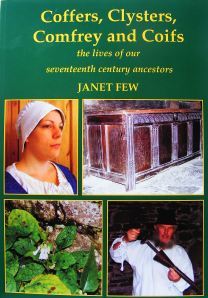
Coffers, Clysters, Comfrey and Coifs: 
the lives of our seventeenth century ancestors 
by Janet Few


You may have found some information and documents about ancestors in the seventeenth century but you probably don't know much about their lives.  This great book by Janet Few will help you with that.  

I met Janet last year and was really impressed with alot of her ideas on the Facebook generation.  This year rather than reaching forward, I was so impressed with her expertise at reaching backward.  Janet is a fantastic resource in seventeenth century British lives.  She has spent alot of time as Mistress Agnes at the living history site Torrington 1646.  As she and her compatriot Chris Braund discussed with me at Who Do You Think You Are Live, you learn so much by trying to live as people did historically.  You come up with all sorts of issues that regular research and study don't teach you.  

This book is full of her wealth of knowledge.  It has chapters on homes and furnishings, household tasks, food and drink, clothing, gardening, medical practices and herbs (scary!) crime and punishment (even scarier!) witchcraft (yikes) and childhood pastimes.  Not only fascinating, the book makes you wonder how your ancestors survived :)  I learned so much that made my ancestors lives so much more real.  It really showed me how much we might put our modern preconceptions on our research and on reconstructing our ancestor's lives.  They lived so differently than we do.  

Besides many interesting facts and lots of wonderful pictures, there are also lots of "ah-ha" moments.  There is a picture of a square wooden trencher where we get the phrase "a square meal."  And when someone was punished in a pillory, their ears might have been nailed to the restraint thus leaving them "ear-marked."  The book is graphic, but realistic.  Lots to learn about the lives of our ancestors.  

Sunday, June 16, 2013

WIFFAC--Books across the pond

I have lots and lots of books to tell you about in this new WIFFAC but I think we'll start with the ones I found furthest back--at Who Do You Think You Are Live.  Even though the world has shrunk so much with the advent of the internet, I'm amazed at how much we don't know about genealogists and genealogy resources in other parts of the world.  Even going through the British course at SLIG, I was again blown away by all the resources at WDYTYAL which I never would have known about.

The first set of books that are such great resources are put out by the Society of Genealogists in London.  Among other publications, they have the "My Ancestor Series" that is fantastic.
My Ancestor was an Agricultural Labourer by Ian Waller
My Ancestor was an Anglican Clergyman by Peter Towey
My Ancestor was an Apprentice by Stuart Raymond
My Ancestor was a Bastard by Ruth Paley
My Ancestor was in the British Army by Christopher and Michael Watts
My Ancestor Settled in the British West Indies by John Titford
My Ancestor was a Coleminer by David Tonks
My Ancestors were Congregationalists by DJH Clifford
My Ancestors were English Presbyterians or Unitarians by Alan Rustin
My Ancestor was a Fremason by Pat Lewis
My Ancestors were Gypsies by Sharon Silers Floate
My Ancestors were Jewish by Anthony Joseph
My Ancestor was a Lawyer by Brian Brooks and Mark Herber
My Ancestors were Londeners by Cliff Webb
My Ancestor was a Merchant Seaman by Christopher and Michael Watts
My Ancestor was a Mormon by Ian Waller
My Ancestor was a Railway Worker by Frank Hardy
My Ancestor was a Royal Marine by Ken Divall
My Ancestor was in Service by Pamela Horn
My Ancestor was a Studio Photographer by Robert Pols
My Ancestor worked in the Theatre by Alan Ruston
My Ancestors were Thames Watermen by James W Legon
How to get the most from Family Pictures by Jane Shrimpton
Tracing Births, Deaths, and Marriages at Sea by Christopher and Michael Watts.
Go to http://www.sog.org.uk and take a look at these and all of the other books around.  There is some fantastic research help there. 

There was also another bookseller that made me wish I could take home suitcase after suitcase of books.  Pen and Sword had so many British History books and they were all so detailed.  Book after book of resources that you don't see at home such as:
Jewish Lives by Melody Amsel-Arieli
How Our Ancestors Died by Simon Wills
Tracing Your Irish Family History On The Internet by Chris Paton
Tracing Your House Hisotyr by Gill Blanchard
Air Force Lives by Phil Tomaselli
Tracing Your West Country Ancestors by Kristy Gray
Tracing Your Ancestors Through Death Records by Celia Heritage
Tracing Your First World War Ancestors by Simon Fowler
Tracing Your Royal Marine Ancestors by Richard Brooks and Matthew Little
Tracing Your Army Ancestors by Simon Fowler
Tracing Your Aristocratic Ancestors by Anthony Adolph
Tracing Your Lancashire Ancestors by Sue Wilkes
The Wills of Our Ancestors by Stuart Raymond
Tracing Your Merchant Navy Ancestors by Simon Wills
Birth, Marriage and Death Records by David Annal and Audrey Collins
Tracing Your Ancestors From 1066 to 1837 by Jonathan Oates
Tracing Your Service Women Ancestors by Mary Ingham. 
And there are several dozen more at http://www.pen-and-sword.co.uk. 

So if you have British ancestors, you'll want to take a look at the offerings from these two booksellers.  There is fantastic stuff on all the details of your ancestor's lives.  Enjoy.

Wednesday, February 20, 2013

Taking my Dad on a Who Do You Think You Are Tour

 Last weekend I got to take my Father back to where his patriarchal line originated in Bradford on Tone and Taunton in Somerset England.  It was such a privilege to get to show him around and help him experience some of the lives of his ancestors.  We stayed in a Yalland's bed and breakfast farmhouse near Taunton.  The room we had actually existed at the time our ancestors were there.  I'm still having a hard time wrapping my mind around the 1600s and the 1700s. 


I took Dad out to my favorite place, the Somerset Heritage Centre and he agreed to be my assistant for some research there for a couple of days.  The people there were so kind and generous to us.  Phil Hawking was very attentive when we had questions and did lots of work to help us uncover more information about our ancestors.  We came home with scores of images that I now get to go through.  When Dad's grandfather first wrote the Vicar in Bradford on Tone around the turn of the century and the Vicar started sending him information about his family from the parish records there, he wrote that a "most enjoyable pastime" ensued as he tried to piece together the records of his family.  I know just how that must have felt. 

Dad came face to face with the wills and deeds I found last year of his 5th and 6th great grandparents.  It is so mind boggling to see the signatures and wax seals on these documents that you know where signed before the Declaration of Independence and Constitution of the United States were signed.  It makes everything so real.  Even that old.

Dad helped me go through the parish registers that hold the records of his patriarchal line.  We digitized several years of records off the microfilm with Dad running the microfilm reader and me running the computer.  It was nice to sit together with him and fun to hear him say, "There's a Carpenter, there's a Carpenter."  We found the marriage records and christening records for many of his ancestors and we're going to have fun going back through and documenting and piecing together the siblings and the families.  Though my university administrator Dad knows how to research, you couldn't call him a genealogist, but I think he had fun. 
 We went to the church in Bradford on Tone where all of these parish records were created.  Here he is with the christening font in the church.  I don't know how old the font is but this is the place where generations of his family were christened.  It is amazing to think this is where they went to church. 

We had a wonderful dinner at the White Horse Inn again.  The people there have been so gracious to us when we have visited and the food is wonderful.  It has been really nice to visit there as many times as I have.  I feel so blessed to have been able to take my children and my father there now and it is so fulfilling to have been able to have been able to share this trip with my family reaching up and down.  
We went to High Street in Taunton where Dad's Great Grandfather was born and where his Great-Great Grandfather had a grocery store.  I haven't been able to figure out where exactly they lived but they lived somewhere on this block that is now a nice pedestrian mall.  We had a nice walk in the morning around Taunton. 
 We visited the churches in Taunton where some of Dad's ancestors were married.  I lucked out this time and every church we went to was open.  It was so exciting to go in and see where these people were married and where they went to church.  We found a Congregationalist church that was built when Dad's Great Grandfather was a young child just down the street from where his family lived.  He grew up to leave the Anglican church and become a Congregationalist minister.  So I'm wondering if that new church had something to do with his going into the ministry.  More research to do.  :)  Here's Dad in front of St. James church where his fifth great grandparents were married just over 250 years ago. 


And as a final treat, after we came back into London, the next day we went out to find the plot in the Gravesend Cemetery where many members of this family came to be buried.  I hadn't scoped this site out before so when we walked in and found this fantastic tombstone it was a great surprise for me. It listed the seven family members buried there including Dad's Great-Grandparents and Great-Great Grandparents. The tombstone was in wonderful shape and had a wealth of genealogical information on it.   Such a fantastic find.

So on my way to speaking at the Who Do You Think You Are Conference this year, we had our own who do you think you are tour.  It was fantastic.  Simply lovely. 

Wednesday, January 30, 2013

Finally I get to tell you--engaging my kids over Christmas Vacation (NEW BLOG announcement)

So with the launch of the book..  (Have you seen it yet?  It's really good ;)  Here's an excerpt.)
I can finally tell you about the AWESOME thing we did over Christmas vacation.  We took the kids to see Trefusis Farm. 

So this is the backdrop on my computer now. Makes me soooooo happy.


Totally, no way, the absolute coolest.  Obviously words fail..  I wrote all about it on my new blog--Zapthegrandmagap.blogspot.com.  You know how you have to be careful about telling people you are out of town and all that..  Well I could write about it over there because none of you knew about that blog yet.  Don't worry.  Now that the book is done, I'll be blogging lots more here too.  But over on the new blog we're going to be posting all sorts of new ideas about engaging your family with their family history.  Lots and lots to talk about in both places.  You'll want to keep your eye out..

Let me know what you think. 

Wednesday, April 18, 2012

Trefusis part 6--The Archives (And she scores!)

So just outside of Taunton, between the city there and our little town of Bradford on Tone lies the beautiful new Somerset Heritage Centre where the archives for Somerset are held. I had no idea what a huge find I was going to make there.
We started out in the maps, confirming what I knew about the parish and where our Trefusis farm is.
And then I got my hands on this... A stack of records on the Carpenters in Bradford. There were so many other documents to look at, but I'm so glad we got to work on this one. This was a stack of gold.
In it was the will of my 9th Great Grandfather John Carpenter. It was a beautiful document with an amazing wax seal attached to the bottom of it. It reads:

In the name of God Amen. I John Carpenter of Bradford in the County of Somerset Yeoman, being weak of body but of sound and perfect mind and memory, thanks be given to almighty God for the same do make and ordain this my last will and testament in manner and form following (That is to Say), I recommend my soul into the hands of the Almighty God and my body I commit to the earth to be decently interred according to the discretion of my executor herein after named, and as for such worldly estate as it has pleased God to bestow upon me I go give and bequeath the same in manner following Item I do give desire and bequeath unto my dear and loving wife Sarah the sum of one hundred and twenty pounds lawful money of Great Britain .....

1721!!!!!!!!!!!!!

And then there was the will for his son Thomas Carpenter my 8th Great Grandfather. Again it was beautiful. Here is the text:

In the name of God Amen. I Thomas Carpenter of Bradford in the County of Somerset Yeoman being Sick of and weak of Body but of sound and perfect mind and memory, called to mind their mortality of my Flesh and willing to settle what it hath pleased God to bestow upon me in this world do make and ordain this my last will and Testament in manner and form following--thats to say I will that my Debts and Funeral finances be first satisfied and paid. Item I give and desire and bequeath unto my four sons--Nicholas Carpenter, John Carpenter, Thomas Carpenter and my son unbaptized (Intended and deigned to be called and named Robert Carpenter) .....

1753!!!!!!!!!!!!!!!!!!!!!!

Then further into the bundle I found several of these bills of sale where Jane and her children sold off parts of the land. They were beautiful huge documents with all of their signatures and wax seals.


The signature of my 7th great-Grandfather John Carpenter, Jane and Thomas' son.
And my 8th Great-Grandmother Jane's signature and seal.
Can you believe it? Unreal. I had no idea I was going to walk into this treasure trove. And I had only a few hours to research and photograph as much as I could. As you probably noticed--there are some different name places in there. And none of them mention Trefusis. Apparently Trefusis comes in later down the line as a part of the lands that were passed down to my line. So I have alot more research to do. Below is a map showing the land ownership of the area from 1802 when some lands changed hands. And I bought a book about how to trace the ownership of land in this archive. I'm going to do as much work as I can from home and then we are going to have to go back. Don't you think?
It's only just whet my appetite. I can't wait to drive on the left side of the road and risk my life again. :) Genealogy happy dance, hum along with me now do do de dah de dah de dah. Whoohoo!

Trefusis Part 5 -- Bradford on Tone

After we visited the farm, we headed back to the little town of Bradford on Tone. It is a beautiful little village across the Tone river from the Carpenter farm. To get there we had to cross the 14th century bridge over the river Tone. The farm is not a far walk from the village, I'm sure that my ancestors crossed it many many times. I wasn't sure we were going to make it across though, I couldn't have had more than 6 inches on either side of the car going across. 14th century!! Isn't that amazing? I can't wrap my mind around how old that is. I'm just glad I didn't knock a hole in it with my car :)

And then we were met with this:
This is the church in Bradford on Tone where generations of my ancestors worshiped and had their religious ceremonies. This is the church where the marriages that formed my patriarchal line originated. It's hard to describe the feelings. I've listened to people tell about their genealogical discoveries and how moving it is. As wonderful as it is to listen to, it just seems like a quaint little church--UNTIL IT IS YOUR LITTLE CHURCH. This one is mine. I feel like I know these people. Way way way back. Thomas Carpenter and Johana Hurtnoll m. 5 Apr 1630, William Carpenter and Joane Meare m. 14 Jul 1656, Thomas Carpenter and Elizabeth Mare m. 1 Feb 1687, Thomas Carpenter born 20 Mar 1702, John Carpenter born 5 Dec 1746, Robert Carpenter born 4 Jul 1783, and Robert Gibbs Carpenter born 3 Oct 1829. I just can't wrap my mind around those dates. That was a loooong time ago.

The town is beautiful. Only a few streets and a handful of houses. We snapped a few pictures here and there.


And then we headed to the White Horse Inn for a late lunch. We had heard from the proprietor of the hotel in Taunton that the White Horse in was a nice pub. And we found it to be just that. The service was attentive and the food delicious. I can't wait to take the family back. They'll love the proper English Sticky Toffee Pudding.

Tomorrow I'll tell you about our Greatest Find on our ancestor hunt. Stay tuned.

Tuesday, April 17, 2012

Trefusis Part 4--The Farm

So this is the continuation of the story about a crazy lady (me!) who took off into the British countryside to find her patriarchal ancestral home. She had heard her whole life of this magical place where the Carpenter family had lived for generations and where her Great-grandfather was able to find and trace their ancestry back to the early 1600s. Trefusis. I told you about or plans here, here and here. I think I'm ready to tell you the rest of the story now.

Notwithstanding driving on the left side of the road, notwithstanding working with a car unlike anything I'd ever driven, notwithstanding dealing with a strange GPS unit, I took off. Luckily I had brought another crazy lady with me--the unflinching Erin Roudabush (well she did flinch once when the car got precariously close to a bush on that side.) The first thing that clicked was that all addresses in England are named. When you live in the countryside at least, each farm or house has a name. You don't live at 10 Waddeston Street, but rather at Waddeston. So coming from the farm "Trefusis" made sense right away. We just had to find this place.

This really is the story of the value of investing your children in their family history. I've been enthralled with this place since I was a little girl. Only because of those years that I wondered about this place did I have the curiosity to find this place and feel out more of my family history along this line. This picture, taken in 1975 shows the descendants of Alvin, my grandfather, son of Joseph Hatten Carpenter. I'm there in the front--oldest grandchild with the purple shorts and white shirt. This picture was taken about the time my grandfather was writing his book about his father. In the picture you can see the sign Grandpa had posted above the door to his house. It read "Trefusis" to honor his own ancestral home. Grandpa had had the sign made, because his father had a similar sign hanging over the house where my Grandfather had grown up in honor of his ancestors. You can see a close up of the picture here. Every time I entered my Grandparent's home, I was reminded of this magical place where we had come from.
I'm not sure where my Grandfather's sign ended up, but several years ago, my sister created a similar sign for my father and for herself. So there have been 4 generations of Carpenters in the US with a Trefusis sign on their homes, harking back to this place, just outside of Bradford on Tone where are ancestors are from.

So probably the most fantastic part of my trip to Great Britain was to get a picture of myself next to the "real" Trefusis sign, along the road at the entrance to the farm. I'm fully aware that this would seem a simple picture to most people, but for me it is just hard to put into words. It is something tugging clear back in the back of my heart. Something really exciting and fulfilling. It was as if several generations were conspiring to pull me back there and I had finally been able to surrender to their wishes.
As it turned out, the farm was beautiful--even in February it was green and lush. We walked up to the home, and knocked on the door, but there was no answer. The house looked much more recent than the picture in my grandfather's book and we couldn't see anything that might resemble that structure. As we proceeded down the street past the fields, there were cows and barns across the way, and more fields surrounding the area. Finally after stealing glances here and there down the street, an older man with two dogs approached us from one of the fields and asked us what we were doing. At this point I was fairly speechless as to what to say to him (you would think all of the things I had planned to say would come to mind, but they did not.) I showed him the copy from my grandfather's book and asked him if he knew where the building in the picture might be. He said he did not and that this home pre-dated my Great-Grandfather's picture. He apparently noticed my Grandfather's explanation above the picture on the page and tried for several minutes to convince me that I was looking for the Trefusis that was in Cornwall (even though Grandfather's explanation was that our Trefusis was *not* the one in Cornwall.) After I could finally get a word in edgewise and tell him that our family was in the Bradford on Tone parish records, he asked me not to take any more pictures and we ended our conversation.

I don't think I was hoping to be invited in for tea, in fact I think I would have been quite uncomfortable imposing on him in any way, shape or form, but I didn't expect someone to be quite so opposed to our presence. Perhaps he felt threatened in some way, I don't know. But I was disappointed to find someone who couldn't be polite and gracious. Oh well. It was still thrilling to be there. He couldn't have put a damper on that no matter what his reaction.

So, despite the farmer, I was thrilled to be able to walk the same roads, and be in the same town that my ancestors inhabited. It is a gorgeous area and I can see why the draw back is so strong. I'll tell you about the town and the beautiful church where so many of my ancestors were married in my next post.

Sunday, April 8, 2012

Janet Few--Harnessing the Facebook Generation--a great lecture at WDYTYAL

I had the opportunity to catch a class by Janet Few at Who Do You Think You Are Live 2012. Her title was "Harnessing the Facebook Generation" so you know I had to check that one out. I learned a lot from her perspective.

She geared her remarks to people who were concerned about the future of their family history research. Janet suggested that getting younger people involved were crucial to ensuring the future of your research. Genealogists need to be concerned about making the hobby attractive to the next generation. She conducted a quick survey at the Devon Family History Society stand at the conference on Friday. They asked Who Do You Think You Are Live attendees whether or not they were worried about what would happen to their research ? Two thirds of the people said that, yes, they were concerned that someone would care about it after they were gone. Genealogists should be really concerned about getting the younger generation involved.

Janet was absolutely right when she stated that we need to be asking ourselves why they are not interested. I think Americans are a lot like the British in saying they have other commitments. It was interesting in the difference between the British and American focus on the archives rather than the Internet. In that way I think Americans may have the advantage in attracting the next generation because we are so focused on the Internet rather than going to an archive. I thought it was amusing that she felt one of the excuses young people might use was that visiting the archives was expensive. It is so much less expensive there than it is for an American to travel to visit an archive, especially archive abroad. Perhaps that is an excuse that Americans can use even when they are older.

I found it very refreshing to hear her assert that if they are interested enough they will find the time and money. She is right. We need to focus on making sure they know how fun and interesting it is, and not worry about the particulars. They will figure the particulars out if they are interested. We just have to make it look exciting.

As I went looking for information about involving children in family history throughout this conference I could see she has an uphill battle in England making the genealogists interested in bringing in the next generation. I found responses such as "I was told as a child to be seen and not heard, so I was never allowed to ask questions about my family history," or "We can't very well have children involved in something as complicated as this.". One magazine editor told me that they hadn't published anything about getting children involved because they didn't believe that interested their readers. One of the major concerns that Janet was facing in her audience was, "Does it matter?". To that lack of concern, Janet asked, "Will the gap be too wide when they get interested later?" I had never thought about it this way, but she is absolutely right that when we don't involve the next generation, we are missing the opportunity to bridge that gap together. We need to involve them now so that it won't be so hard for them when they become interested as they become older. She also asserted that we need the tech generation to help us preserve our history. We need them as much as they need us. But we have to present it in a way that is interesting. They aren't interested in doing genealogy the way we do it.

I loved her ideas about the Facebook generation being educated differently and that the way they get info is different than the way older people access information. To attract young genealogists we need to look at the way they access information. I agree with her that they go straight to the Internet and then only sometimes do they ever get to books. I'm not sure that I agree that they are more likely to look for name in Facebook than in google, but she very well may be right. Janet talked about the Braund Family Group on Facebook. She noted that there are 200 members of the society in real life, and 200 members on facebook, but only 40 of the actual members are members on facebook--thus the facebook group attracted 160 people to their cause. Of those, she estimated that 108 are estimated to be under 30 years old. She spoke of her experiences as a young family historian. She said when she joined the Braund One Name Society, at the age of 30 she was one of 4 young members and she was amused to find that 24 years later she was still one of the youngest members. She was excited to have the society on Facebook, and felt that this was the place where most young people would go to search for information about their family. She feels that Facebook is the best way to talk to youth. Though social networking isn't a substitute for a mailing list or blog, she also noted that a local journalist was following them on twitter, yea--free publicity. But does it really help your research? For youth, a facebook group is a great place to ask questions. It is also a great place to share photos and info.

Janet had some great examples of getting younger people involved with their family history. The first, is a children's website put together by the Devon Family History Society, the Acorn Club. She said you need to ask young people how to develop a website for them. She also showed off Captainjamesbraund.wordpress.com where a doll goes from member of the family to member of the family and writes letters on the blog. Janet also recommended the Horrible Histories TV show on the BBC. We had a great time watching some of the clips on youtube. My favorite is the Tudor Diet Plan. Like I've said here too, you need to do it in a youthful way. If kids were attracted to the way we do genealogy, we'd already have way too many children interested. So we have to rethink. Janet had some great ideas.

Janet's handout can be found at http://www.sog.org.uk/events/pdf/2012-Show-Handouts/WDYTYA-20120226-Harnessing-The-Facebook-Generation.pdf You can bet I'm following her on facebook. You should too.

Monday, March 12, 2012

WDYTYAL Marketing differences between England and America

I don't know that very many people will be interested in this like I am but I'm going to add this to my WDYTYAL analysis. I learned alot about how differently the consumers in America approach a "booth" at a genealogy conference vs. the way consumers in England approach a "stand." Perhaps any readers might glean something else here that we can learn about how to create a stronger genealogy community.

Broad Sweeping Generalizations Alert again:

The first thing we noticed was that very few people would take a flyer or sign up for our newsletter. We found this really different than American conferences. Like I said in the earlier post, in England they would look and analyze you, perhaps even pick up a flyer and read it, and then put it back down. In America I think we are in too big of a rush and everyone just wants to collect the contact information to be able to look at your website later. Perhaps it is a greater sense of environmentalism, or perhaps minimalism too because in America, two or three people in a group would each take a flyer, but a group in England would only take one to share. The question I was left with though is how do people remember what they saw at the show so that they can utilize these resources later?

Likewise, the British stands had very talkative displays, signs with paragraphs and paragraphs for you to read. In America I'd been taught that you have 3 seconds to catch their eye so you keep your display clean (which we're not terribly good at since we give the user so many options) and put the details down on the table or in the flyer. Again, it seemed I had a minute or two to catch a British person's eye. They would really stop and look. It was so refreshing. Perhaps I brought some of that calmness home and that is why I haven't been frantic to get these blog posts written immediately. Social Networking has given us Americans an even stronger sense of being hectic, so I've just been getting back to my British roots.

I thought it very interesting that there weren't many flyers or bowls of candy at the booths. In the States, we fill up big bowls of candy and hand out stacks of flyers. At WDYTYAL there were generally a few pieces of candy sitting on the table with the rest stashed behind a sign if there was candy at the stand. I generally think that candy doesn't attract a person to your booth for the right reasons, so it was interesting to see the differences there.

The biggest difference though was just in the way people interact with stand representatives. It was utterly fascinating. In America we go bounding up to people, all bright and smiley and engage them with what we are doing. If someone has to stand there for very long, they get impatient so when there are lots of people at the booth, you try to talk to a few people at a time, telling them to "let me know if you have any further questions." In the States, people will stand and soak it in a little, and then if they do want more information, they'll wait until you are free, but they expect to at least catch your eye quickly. If you were not to approach a consumer who came to the booth, you would be seen as standoffish and the American consumer would assume that you didn't want their business, or would be too hard to work with.

British consumers are the complete opposite. It seemed they don't want to be approached as much, they wanted to browse. And the people working the stands wouldn't talk to the consumer unless they were talked to. It was almost as if the person working at the stand was there as a servant--let me be at your beck and call. They stand at attention, quietly waiting, in case you need anything. In fact, when we looked away to another customer, or said "let me know if you have any questions," I think they were put off and would leave. It was as if I was a servant in an episode of Downton Abbey, or perhaps more closely, one of the shop girls in the Britcom Are You Being Served. The "shop keepers" were very attentive and would literally stand there for 5 minutes or more not saying anything. After a long while, at the most, they would say "Are you ok there?"

Well if you know Erin and I, you know that went against every grain of our bouncy, smiley selves. I felt like I was hovering to stand quietly at attention. It was against everything I naturally do. So we were in for a bit of a culture shock that way and found it a fun challenge to try to adjust. One time it was quite amusing, while talking to Dick Eastman, a customer came up, and in his generous way as he always does, Dick stood back so that I could attend to the other person. When I didn't say anything to the customer, but rather stood there, and then after a few minutes asked "Are you ok there?", I think Dick thought I was being rude. He wandered off so that I could be more attentive and I never had another chance to talk to him. I'm sure we'll have a good laugh next time I see him.

I'm sure there were lots of other things that were different, the use of color, the constructed stands (one conference organizer I talked to who had done shows in the States said she thought Pipe and Drape was strange :) I think it was nice to have a real wall to hang things on), the proper British spelling, and many other subtleties. I had several people tell us that we would be successful just because we were American. I'm not so sure. I got the impression that younger people loved the Americans more than the older people do.

I've traveled to most every continent on the earth, and we have customers from every continent (except Antartica :)) I love British TV, we've all listened to British music, of course British fashion is very influential here, etc, etc, I didn't expect our cultures and especially marketing to be so different. But with some further study I think we've generally got it figured out. The jury is still out, and the orders are still coming in but I think we'll be going back to WDYTYAL but with a whole different approach. It was a great experience and really exciting to get to try out something new. The world isn't as small as we had thought and that makes it all the more fun doesn't it?

Saturday, March 10, 2012

What Americans need to learn from the British about Genealogy Conferences

There are two main points that sum up the differences between WDYTYAL and American genealogy conferences.

Alert: Broad sweeping generalizations again. I know it. Just my general observations. Don't take them all too seriously.

First, there is an exhibitors lounge but no speakers lounge. At WDYTYAL it is all about the vendors. There are only four classes going at a time and they are taught in open classrooms. The classes are on the outskirts of the vendors' hall, and they are only surrounded by a wall that is waist high. Thus you can come and go as you please, you can stand on the outside of the wall and eat a sandwich, and wander off it the speaker gets boring.

You can pre-purchase a seat in one of the lectures for a pound or two. But that is only if you think they are going to be sold out. Otherwise, you just wander in and out. Lecturers aren't paid. Even the well known lecturers make their living not from their lectures, but from an affiliation with a company, or from doing research. I was told they get paid 300-400 £ for lecturing to societies, but not a pound for speaking at this conference.

And that is again a major difference in American and British genealogy. The societies tables were buzzing--much more than the commercial side of the hall. The societies there are healthy and could afford to pay that much--here not so much. I think--but I'm not sure--that those societies are healthier than ours because it is all about the "Local History" and the experts that these societies have that are specialists in the history of the area. Again, it just doesn't translate here in this nation of migrants.

Secondly, British people come to the conferences to DO genealogy research. Americans come to conferences to LEARN HOW to do it. There was lots of research going on at WDYTYAL. Every large booth had computers in it where the users could try out a database, or free consultations where you could sit down to talk to an expert. The users would wait in long lines for their turn to talk to someone. When we have put up computers at our booths in America we have a hard time getting anyone to sit down and try it. Americans just want to get in and get out quickly, and then go home and do it later.

I'm not sure we can replicate that coming to DO genealogy at an American conference. In order to do that we would need to replicate the leisurely pace of the conferences and that's not the way conferences go here now. It was not rushed, but rather like spending the afternoon in the pub. I found that refreshing about England in general, and hated to come home to the rush and hubbub. When you go to your local pub for dinner, it may take you three to four hours to eat, no in and out so that someone else can have your seat like it is here. When we sat down to eat at one place, we had an hour before we needed to get to our show--after the waitress came 10 minutes later, we asked if we would make it and she said no. The other night, Kim and I were in and out of Chili's in less than an 1/2 hour to be able to get to a show here. Everything is just less rushed there and I like that much better.

Having paid 20£ to get into the hall, they weren't in a hurry to leave either. Here it seems you pay $300 to go to the lectures and so you are stressed to make the most of that. As you saw in the pictures, the tables and chairs that were all over the conference were constantly full. There was lots of food, and no reason to leave. We could do much better in the food department at our conferences. I think people are much more inclined to slow down and mill around when there is good food available.

I found the difference most striking when I was walking around the conference looking for information for my own research. I found myself taking flyers and pamphlets so that I could look at their information online later, because I was in too big of a rush to get on to something else. We got the feeling that the British people there weren't doing that at all. They would look at a booth, talk to the people, and analyze them right there and then.

I like the conference where you can come and DO your research. I think it works better than coming to learn, because in America you come to a conference and after the first day or so your brain is full. I see alot of beginners walking around conferences here with a kind of zombie look. Of course in England, the users only come for one day. It wasn't anything like the 3 day gorging on lectures we do around here.

It really boils down to a difference between a "home and garden show" and a scholarly conference. We're more relaxed when were out at the home and garden show. In America, genealogy conferences are built on the scholarly conference model and that will never get us a very large audience. If you haven't read Mel Wolfgang's blog posts on this topic, you should:

Genealogy Conferences Long Time Passing
The Speakers, Big Bucks and Maybe a Turducken
Some Thoughts on the Money Thing
Volunteers and the Exhibit Hall
If I had a Crystal Ball and A Magic Wand
Conferences and Events: Getting it Right

If we built our conferences to be closer to the boat show, or even the state fair, I think we would be able to attract more people to the hobby.

Thursday, March 8, 2012

WDYTYAL-What makes a successful genealogy conference--in pictures.

If you want lots and lots of people at your conference...Make sure you have a few excellent speakers. :)
Bring in an antiques appraiser.
Let them come to research their family history, not just learn how to research.
Add lots of local experts with one on one time.
Have great food. Above is the "Proper English Sausages" booth and here is my felafel/sweet potato wrap that was really good. There were smoothies and soup and salads. No need to leave.
Add a living history section where you involve the local woodworkers,
Historical reenactments,
The Lace Maker's Guild and etc.
Open Classrooms. You can buy an inexpensive ticket to reserve a seat, but you are also welcome to just saunter around. Classrooms were completely integrated into the vendor's hall.
Add an Exhibitor's Lounge. (There was no speaker's lounge) That speaks volumes to what was different doesn't it?

Encourage people to sit around and make a day of it. All of the 100s of tables and chairs were constantly full.
Add an Ask the Experts. Busy Busy Busy
Photography Daters. Our own beautiful Maureen Taylor sharing her expertise.
And then if you are really ambitious, you can even add a booth for training guide dogs.
Who doesn't love pictures of puppies at a genealogy conference ;)
We're going to work on some of these ideas for the upcoming UGA conferences. What do you think?